
A new C-suite (such as a CEO) arrival creates a rare opening; the organization’s culture is malleable, expectations are being reset, and teams are watching closely for signals about what kind of leadership era is beginning. For HR leaders navigating this critical window of a leadership transition, you have a narrow but powerful opportunity to shape how that era starts. One of the highest-leverage strategic moves you can make is championing a 360-degree feedback program for executives and managers.
Launching an executive 360 feedback program during a leadership transition provides an incoming CEO with immediate, diagnostic data on leadership team dynamics, surfaces behavioral blind spots, and establishes clear behavioral expectations aligned with the new strategic direction.
At OrgVitality, we work with organizations to design these leadership architectures intentionally. By pairing our flexible 180 and 360 assessment platforms with structured development, we help HR leaders present a data-driven talent strategy that aligns perfectly with a new CEO's business objectives.
Let's dive into how to build a strategic case, structure the program for success, and present the initiatives to enable the business.
Why 360 Programs Matter More at the Top
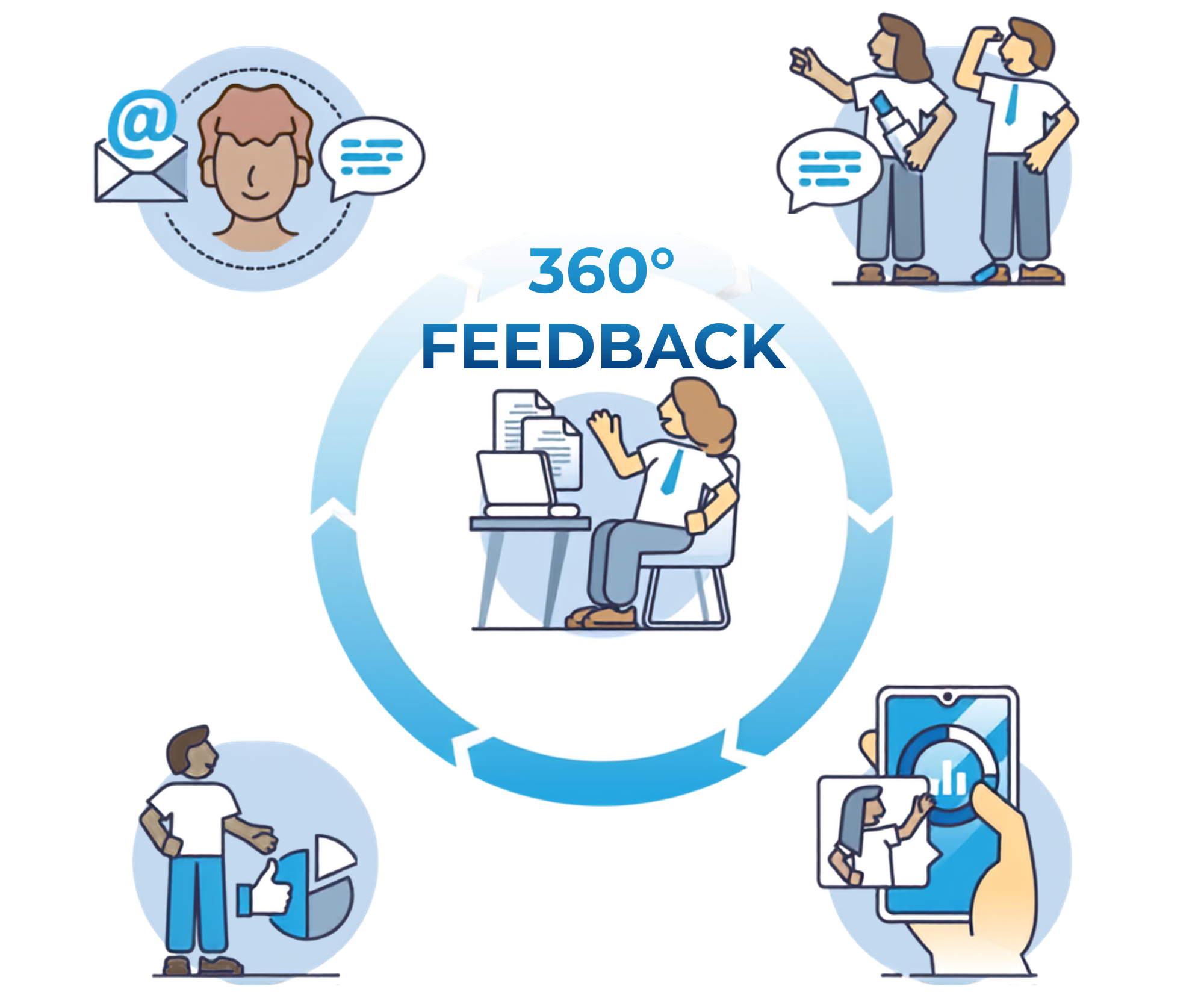
Every new CEO faces the same challenge: they inherit a leadership team before they truly understand how it functions on the ground. Formal reviews, board perspectives, and early one-on-one meetings provide pieces of the picture, but they miss the day-to-day reality. A thoughtfully designed multi-rater 360 process offers a complete view of how leaders are experienced by the people around them every single day.
Research in executive assessment suggests that the higher leaders rise in organizations, the less candid developmental feedback they actually receive. Direct reports often feel unable to be entirely honest. Others may simply assume that anyone in a leadership position must know best, making them hesitant to question decisions or provide critical upward feedback.
Consequently, senior teams often operate on unverified assumptions about their own effectiveness, which are frequently flattering yet regularly wrong.
How does a 360 feedback program help senior leadership?
A well-designed 360 program interrupts the isolating dynamic. By systematically collecting structured, anonymous input from direct reports, peers, and managers, the process surfaces the exact behavioral blind spots that derail otherwise talented executives. Research on executive derailment consistently points to common themes in
-
relationship failures
-
poor interpersonal skills
-
difficulty adapting
-
a failure to develop others
These are exactly the dimensions a 360 multi-rater assessment is designed to illuminate.
For a new CEO, this diagnostic data is invaluable. They are inheriting a leadership bench whose strengths and talent gaps are entirely unknown to them. A structured 360 program accelerates their understanding, replacing superficial early impressions with objective signals from across the organization.
The Strategic Case: What a 360 Program Does for the Business
When presenting this strategy, it's vital to focus on business relevance. A well-timed assessment program drives impact across 4 distinct pillars.
Embedding Shared Leadership Expectations
Launching a 360 program allows you to formalize or recalibrate your organization's unique leadership competency model. This process signals to the entire enterprise that specific behaviors, such as how leaders communicate, develop teams, and navigate conflict, are now being measured and prioritized. This signal shapes organizational behavior long before the first feedback report is delivered.
Accelerating Leadership Development ROI
360 feedback guides participants to the most impactful priorities for their own development as leaders and provides actionable feedback. This foundation provides a far richer foundation for developmental planning than self-assessments alone for their leadership evolution, particularly when paired with professional coaching and clear accountability loops.
Coaching engagements are significantly more effective when anchored to objective 360 results.
Reducing Leadership Turnover Risk
Turnover at the director level and above is extraordinarily costly. Most industries' estimates range from 1.5 to 3 times a leader's annual salary when recruiting, onboarding, and productivity loss are factored into the equation. A 360 program that identifies struggling leaders early allows for targeted developmental intervention before the organization pays the full financial and cultural price of a failed placement.
Build Top-Down Psychological Safety
When executives participate in 360 reviews and are seen doing so openly, it sends a powerful message that seeking feedback is a core leadership value, not a sign of weakness. This transparency establishes a healthy norm that quickly cascades down through every tier of management.
Designing the Program for Success
There are four distinct characteristics of a successful 360 feedback initiative:
- Strict Confidentiality: The process must be professionally administered by an objective external partner to guarantee rater anonymity and protect psychological safety.
- Strategic Alignment: The competency model must be tied directly to the organization's current business goals and desired culture.
- Structured Accountability: The assessment cannot be a standalone event. It must be followed by coaching and clear expectations for action planning.
- Transparent Communication: The purpose of the program must be entirely clear. If the data will be used to inform talent decisions rather than being purely developmental, that distinction must be clearly communicated from day one.
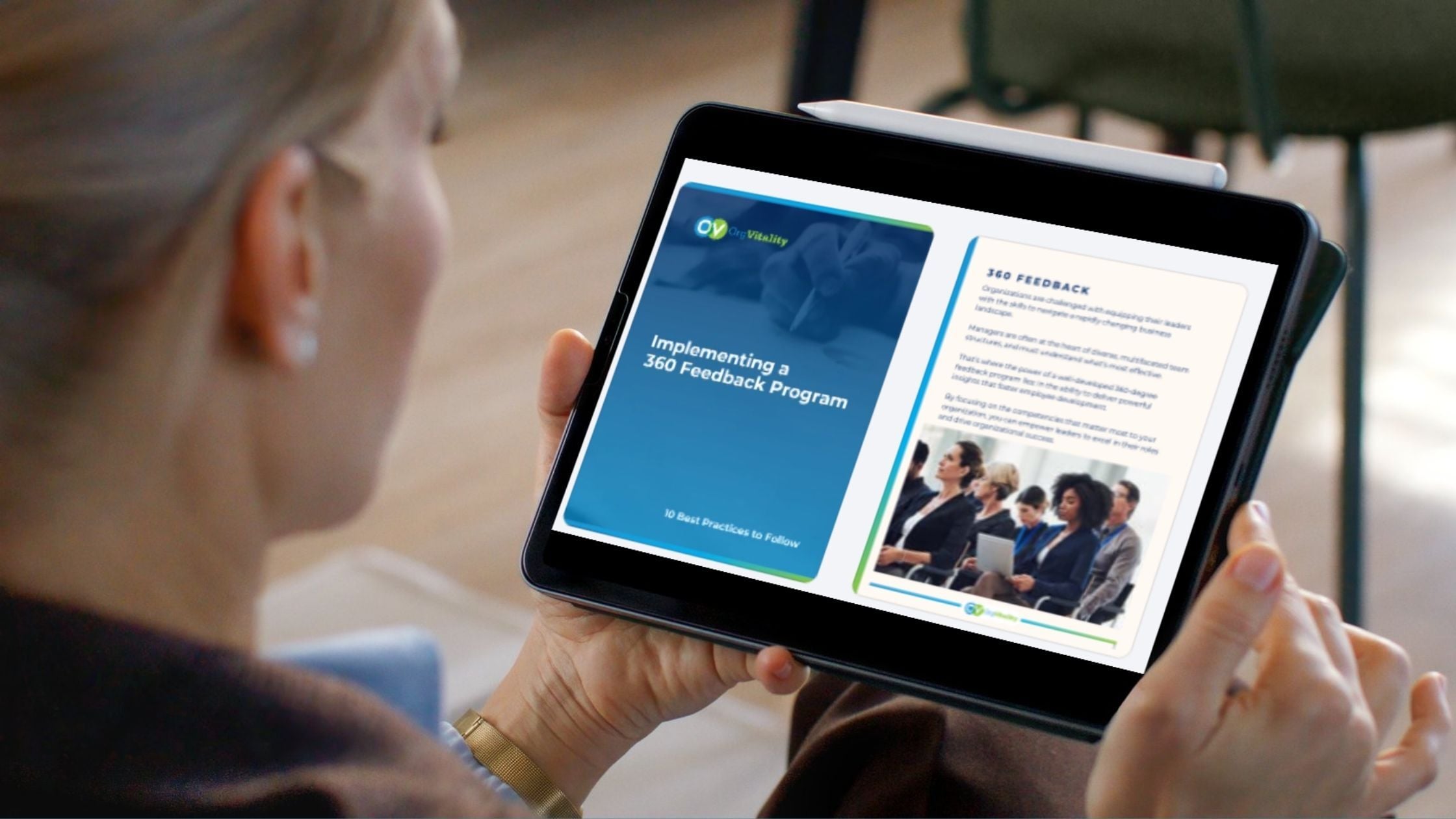
For 10 best practices for your 360 program, read OrgVitality's Implementing a 360 Feedback Program.
How to Secure Buy-In from the New CEO
The most common mistake HR leaders make is leading with the process itself, such as explaining the design, competency framework, and reporting structure. While that can feel intuitive, to secure buy-in from a new CEO, you must lead with their specific business agenda.
Determine what they were hired to fix and what they have stated publicly about organizational culture. If the incoming leader prioritizes accountability, anchor the 360 framework there. If they talk about succession readiness, frame the program as an instrument for talent mapping. Make the program an instrument to drive their strategy, rather than an HR deliverable.
To position the 360 program effectively for leadership, leverage these four specific tactics:
- Present the Evidence. New CEOs respond to data-backed evidence. If the leader has a background in consulting, finance, or operations, this can be particularly impactful. Share research on executive derailment and proven ROI of feedback-rich organizational cultures to ground your pitch in business logic.
- Embed the CEO in the Process. Offer to include the CEO in the initial cohort, ideally timed for 6 months into their tenure. This is a bold recommendation, but it demonstrates absolute commitment to the process and immediately establishes organizational-wide credibility. Many new CEOs, particularly those who see themselves as learners, will accept.
- Propose a pilot, not a program. A 12-month pilot with a focused cohort of senior leaders and clear evaluation criteria is far easier to approve than an immediate, enterprise-wide rollout. Secure an early win with the senior bench, then expand.
- Identify a champion. If you can brief one or two members of the executive team before the CEO conversation, you walk in with momentum rather than building it alone. Chances are that some members of the team benefited from a 360 in the past; if not recently, then earlier in their career.
- Don’t oversell. A 360 is not a direct measure of absolute performance or a direct measure of future potential. Rather, it reveals how leadership behaviors are experienced by the people who work with that leader every day.
Sustaining Momentum
A frequent pitfall of a traditional 360 program is the "one-and-done" effect. Leaders receive their feedback, build an action plan, and have no objective way to measure progress before the next annual or biannual review cycle.
At OrgVitality, we solve this continuity challenge through our Developmental Check-In (DCI) assessments.
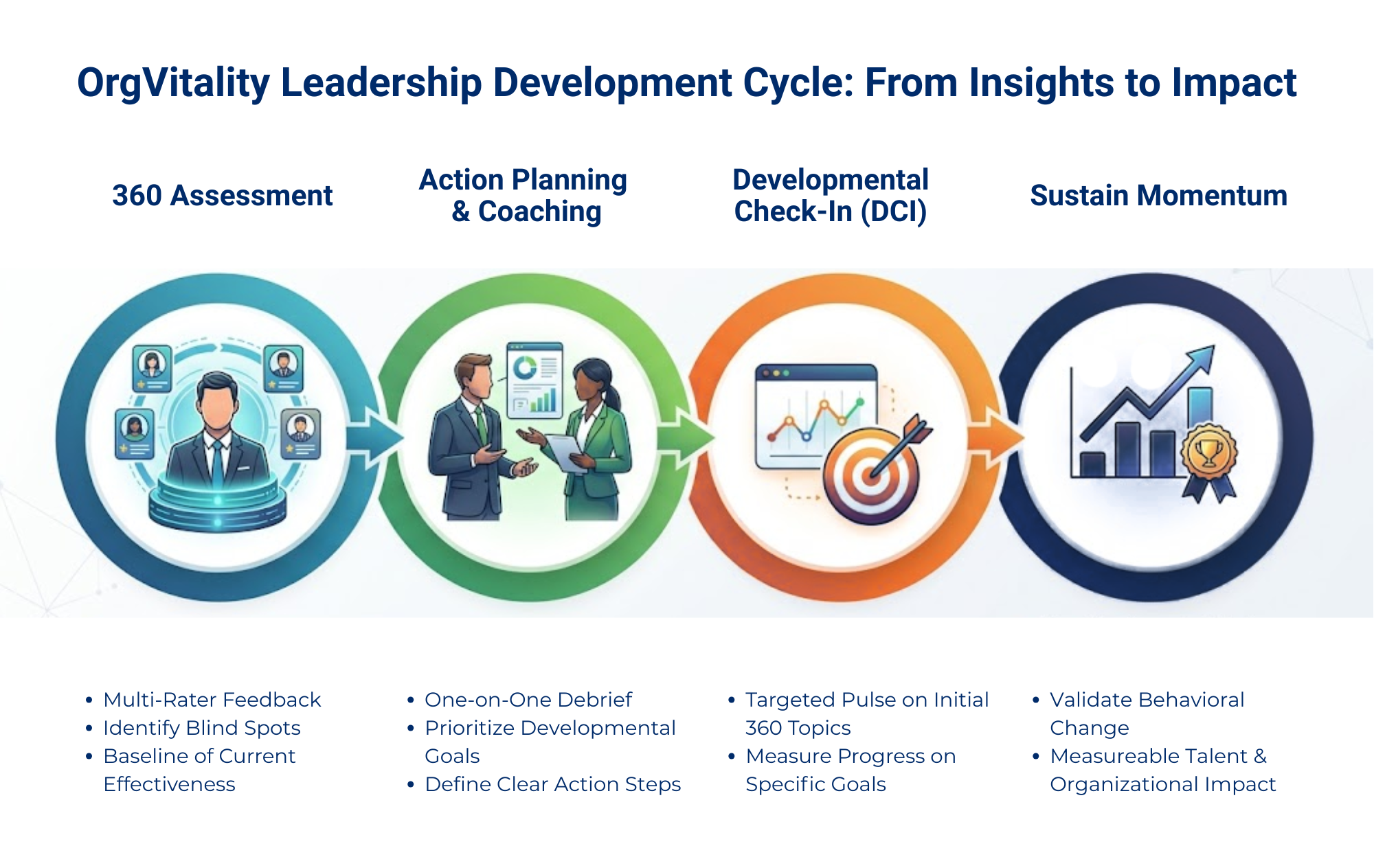
A DCI is a highly targeted, brief assessment offered between standard 360 cycles. Instead of tracking entirely new feedback or introducing an updated competency model, DCIs focus strictly on the specific action items the leader committed to during their coaching sessions. This approach allows the raters to share whether they have observed measurable behavioral changes. It keeps development top-of-mind, provides data to verify progress, and ensures that your leadership development investments yield a clear, trackable talent impact.
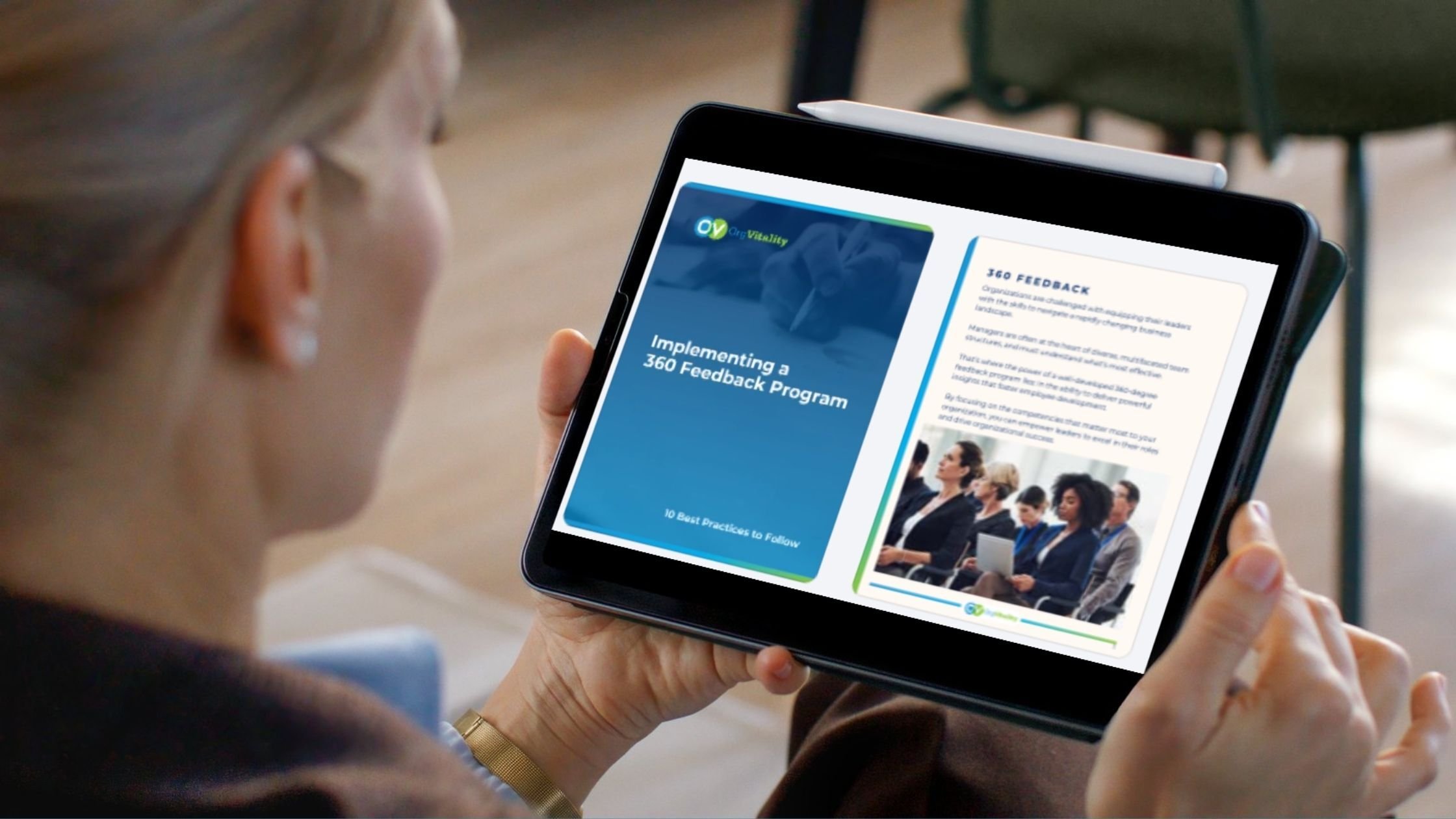
Read about the 10 best practices to ensure your 360 program has in OrgVitality's Implementing a 360 Feedback Program ebook.
Act Before the Window Closes
Leadership transitions are time-limited opportunities. In the first year, a new CEO is actively forming opinions and remains highly open to systemic inputs about how to optimize the organization they've inherited. The window to plant the right seeds to build an intentional culture where leaders actively seek and act on feedback closes faster than most HR leaders expect.
A new CEO will inevitably shape the organization's culture. The real question is whether that culture will be shaped intentionally or by default.
A 360 program, launched thoughtfully in the first year of a new CEO’s tenure, can become a defining feature of the new leadership era. Your job is to make the case before that window closes.
By launching a confidential, strategically aligned 360 feedback program supported by coaching and continuous check-ins, you give your leadership team the mechanism they need to align around shared expectations and model continuous development from the top down. Few talent investments made during a transition window have the potential to influence leadership culture as broadly or as durably.
Should a new CEO participate in a 360 feedback program immediately upon arrival?
No, a new Ceo should typically wait six months before launching their own 360 assessment to allow enough time for team members to observe their leadership style and decision-making patterns.
Introducing a 360 assessment too early gives data based on superficial impressions rather than behavioral trends. However, announcing the program's future rollout during the first 90 days is an excellent way for the CEO to signal a commitment to transparency and development.
How do we ensure busy leaders actually act on their 360 feedback reports?
Ensuring leadership action requires pairing the feedback report with a mandatory post-assessment coaching debrief and structured action template. Without a coach to help debrief, leaders often suffer from analysis paralysis or action becomes deprioritized compared to other priorities.
To solve this, OrgVitality couples robust reporting with expert developmental coaching and targeted Developmental Check-Ins, transforming feedback into a continuous, accountable cycle of leadership growth.
Best Practices for an Impactful 360 Feedback Program
10 Best Practices for Implementing a 360 Feedback Program can be found in OrgVitality's ebook. Download your copy
Author

Jerry Seibert, M.A., is an executive consultant at OrgVitality. He has 30 years of experience working with organizations to measure and improve customer, employee and other stakeholder perceptions. In addition to leading a wide range of customer engagements. Jerry has also led research in internal customer service and its connection to business outcomes. He has designed and implemented employee surveys for numerous organizations, ranging in scope from global entities to small privately held firms. He is the co-author of Hidden Drivers of Success: Leveraging Employee Insights for Strategic Advantage, published by SHRM in 2013, and has more than 20 publications to his credit in a variety of peer reviewed and professional journals. He received his M.A. degree in Industrial/ Organizational Psychology from Western Kentucky University in Bowling Green. He has a B.A. in Psychology from the University of Delaware.